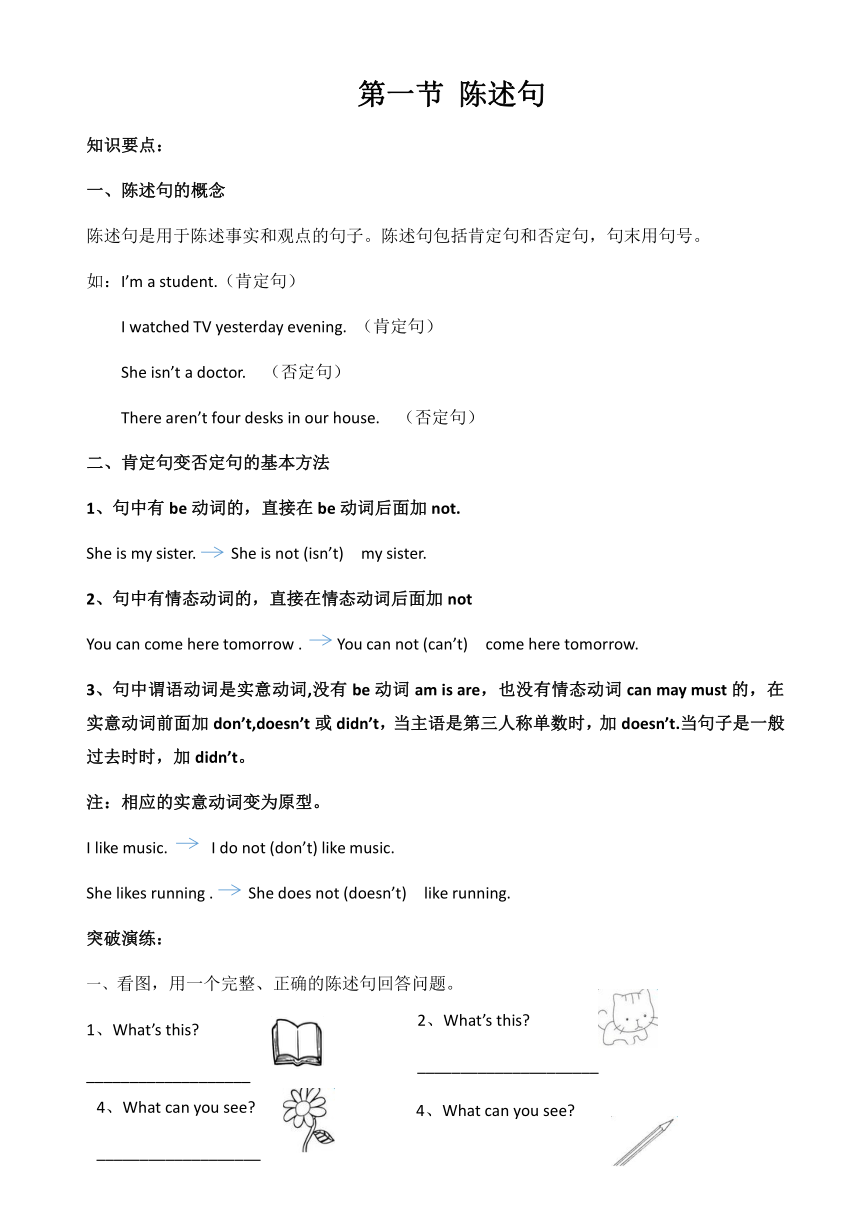
陈述句 知识要点: 一、陈述句的概念 陈述句是用于陈述事实和观点的句子。陈述句包括肯定句和否定句,句末用句号。 如:I’m a student.(肯定句) I watched TV yesterday evening. (肯定句) She isn’t a doctor. (否定句) There aren’t four desks in our house. (否定句) 肯定句变否定句的基本方法 1、句中有be动词的,直接在be动词后面加not. She is my sister. She is not (isn’t) my sister. 2、句中有情态动词的,直接在情态动词后面加not You can come here tomorrow . You can not (can’t) come here tomorrow. 句中谓语动词是实意动词,没有be动词am is are,也没有情态动词can may must的,在实意动词前面加don’t,doesn’t或didn’t,当主语是第三人称单数时,加doesn’t.当句子是一般过去时时,加didn’t。 注:相应的实意动词变为原型。 I like music. I do not (don’t) like music. She likes running . She does not (doesn’t) like running. 突破演练: 一、看图,用一个完整、正确的陈述句回答问题。 What’s this _____ 二、将下列句子变成否定句,每空一词。 This is a desk. This _____ a desk. He can draw pictures. He_____ draw pictures. He has a nice watch. He_____ _____ a nice watch. I played the piano yesterday. I_____ _____the piano yesterday. You must do your homework first. You_____ do your homework first. 疑问句 知识要点: 疑问句的概念及类型 疑问句是用于提出疑问的句子。疑问句句末应有问号,疑问句可分为一般疑问句、特殊疑问句、选择疑问句和反义疑问句四种。 如:Are you a student (一般疑问句) Do you like English (一般疑问句) What are you doing (特殊疑问句) Is your friend a boy or a girl (选择疑问句) You like English,don’t you (反意疑问句) 一般疑问句:是指询问事实的句子,此类句子必须用“yes”,或“no”来回答。 1、句中有be动词的,把be动词提到句首。 He is a writer. Is he a writer 2、句中有情态动词的,把情态动词提到句首。(must, may, can,…) I can clean the window. Can you clean the window 句中谓语动词是实意动词,没有be动词am is are,也没有情态动词can may must的,在句首前面加do,does或did,当主语是第三人称单数时,加does,当句子是一般过去时时,加did。 注:相应的实意动词变为原型 He likes cows. Does he like cows 三、特殊疑问句:以特殊疑问词(what , where , who , which , when , whose , why , how, what time, what colour, how often, how many, how much, how old等)开头引 导的句子。此类句子应该问什么就答什么,不能用“yes 、no”来回答。其基本结构是“疑问词+一般疑问句” 将下列句子改为一般疑问句。 This is a nice watch. _____ this a nice watch I’m going to the zoo this Saturday. _____ you _____ to the zoo this Saturday Jim can help you with your English. _____ Jim _____ me with my English Lucy looks like Lily. _____ Lucy _____ like Lily I go to school everyday. _____ you _____ to school everyday I played the piano last night. _____ you play the piano last night 二、用适当的特殊疑问词填空。 祈使句 知识要点: 祈使句的概念 祈使句是用表示请求、命令、劝告、祝愿或建议的句子。祈使句的主语一般为第二人称,但往往省去不用。 如:Please be quiet!请安静! Let me help you.让我来帮你吧。 Don’t open the door.不要开门。 二.祈使句的结构 1、祈使句的谓语总是用动词原形,其结构为“动词原形+宾语+其他”。 如:Be careful!当心 ... ...
~~ 您好,已阅读到文档的结尾了 ~~