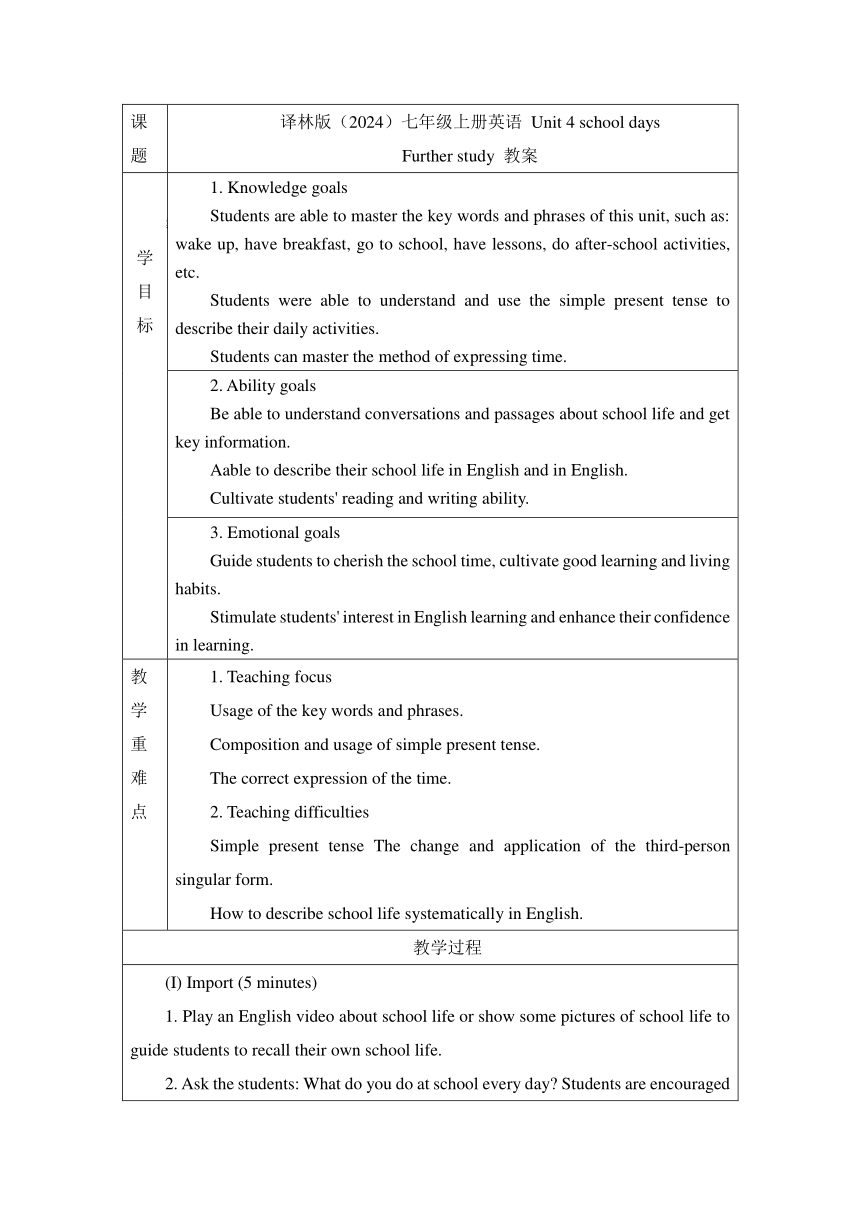
课题 译林版(2024)七年级上册英语 Unit 4 school days Further study 教案 教学目标 1. Knowledge goals Students are able to master the key words and phrases of this unit, such as: wake up, have breakfast, go to school, have lessons, do after-school activities, etc. Students were able to understand and use the simple present tense to describe their daily activities. Students can master the method of expressing time. 2. Ability goals Be able to understand conversations and passages about school life and get key information. Aable to describe their school life in English and in English. Cultivate students' reading and writing ability. 3. Emotional goals Guide students to cherish the school time, cultivate good learning and living habits. Stimulate students' interest in English learning and enhance their confidence in learning. 教学重难点 1. Teaching focus Usage of the key words and position and usage of simple present tense. The correct expression of the time. 2. Teaching difficulties Simple present tense The change and application of the third-person singular form. How to describe school life systematically in English. 教学过程 (I) Import (5 minutes) 1. Play an English video about school life or show some pictures of school life to guide students to recall their own school life. 2. Ask the students: What do you do at school every day Students are encouraged to answer in English, such as: I have lessons, play sports, etc. (Ii) Word learning (10 minutes) 1. Show the key words and phrases of this unit, such as: wake up, have breakfast, go to school, have lessons, do after-school activities, etc., and lead the students to read aloud and explain its meaning and usage. For example: wake up means "waking up", the common phrase wake up early / rate (early / late). have breakfast For "breakfast", similar phrases include have lunch (lunch), have dinner (dinner). 2. Help students consolidate the vocabulary learned through pictures and example sentences. Show a picture of the student getting up and say: He wakes up at six o'clock in the morning. Show a picture of a student eating breakfast, saying: She has breakfast at seven. (3) Grammar explanation (15 minutes) 1. Introduce the concept of the general current time, and explain its composition and usage. Simple present tense Indicates the frequent action or state of existence, its composition is divided into two situations: subject + be (am / is / are) + other; subject + verb original form / verb third person singular form + other. 2. Focus on the change rules of the third person single form of the verb. In general, -s is added to the end of the verb, such as play-plays, like-like. Verbs ending with s, x, ch, sh, o, and add-es to the end, such as: watch-watches, go-gos. A verb ending with "consonant + y" changes y to i and adds-es, such as: study-studies, fly-fries. 3. Let the students understand the usage of the current tense. I am a student. (General present time of the be verb) He likes playing football. (The s ... ...
~~ 您好,已阅读到文档的结尾了 ~~