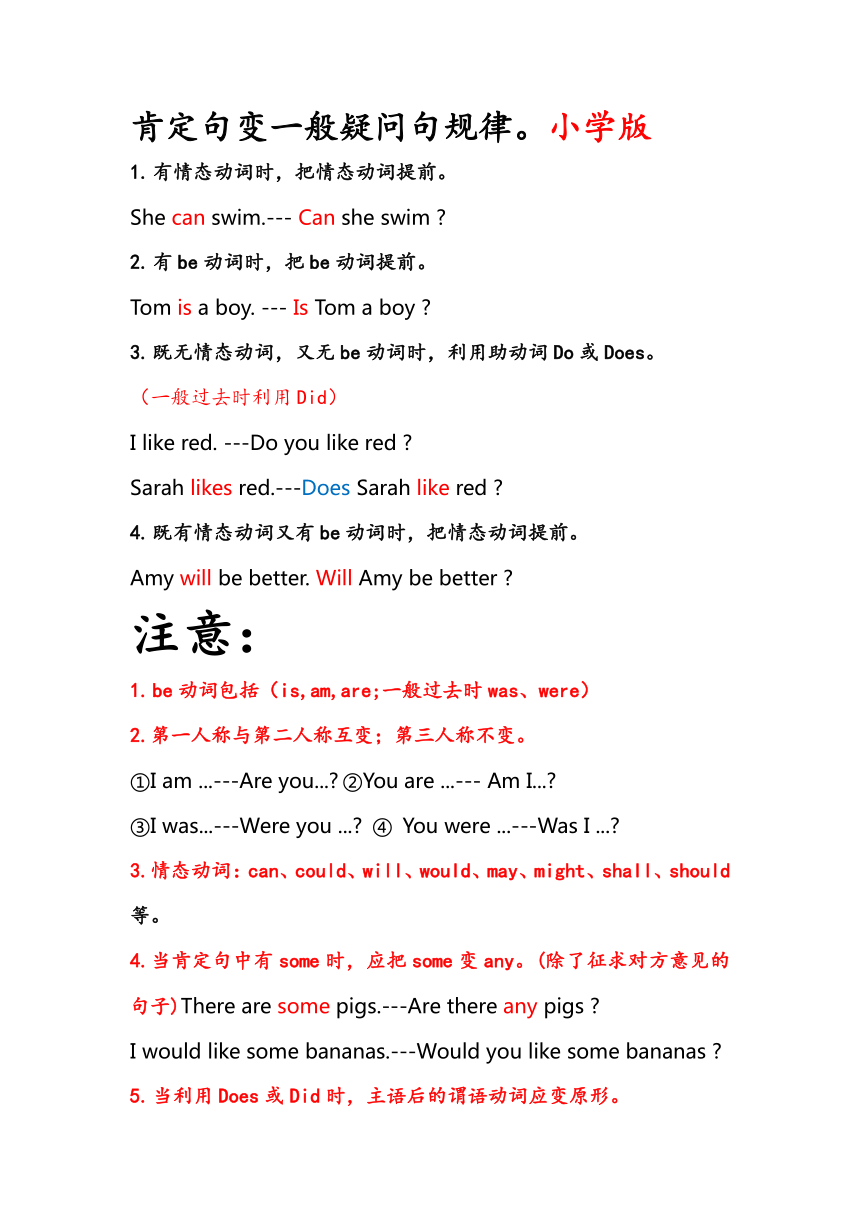
肯定句变一般疑问句规律。小学版 有情态动词时,把情态动词提前。 She can swim.-- Can she swim 有be动词时,把be动词提前。 Tom is a boy. -- Is Tom a boy 既无情态动词,又无be动词时,利用助动词Do或Does。 (一般过去时利用Did) I like red. --Do you like red Sarah likes red.--Does Sarah like red 既有情态动词又有be动词时,把情态动词提前。 Amy will be better. Will Amy be better 注意: be动词包括(is,am,are;一般过去时was、were) 2.第一人称与第二人称互变;第三人称不变。 ①I am ...--Are you... ②You are ...-- Am I... ③I was...--Were you ... ④ You were ...--Was I ... 3.情态动词:can、could、will、would、may、might、shall、should等。 4.当肯定句中有some时,应把some变any。(除了征求对方意见的句子)There are some pigs.--Are there any pigs I would like some bananas.--Would you like some bananas 当利用Does或Did时,主语后的谓语动词应变原形。 练习题(肯定句变一般疑问句/并做出肯定回答和否定回答) She is my mother. He often helps me. He and she are my parents. I like him. He likes me. I am a teacher. Lucy does her homework every day. This is a duck. These are yellow rulers. She and I often go for a walk. She has some rulers. We close the windows. She can go to school. He should play sports. His name is Zhang Peng. Liu Chao is a factory worker. You are beautiful. There are two boys in the room. Tom always washes his clothes. They are girls. I would like some fish for lunch.
~~ 您好,已阅读到文档的结尾了 ~~