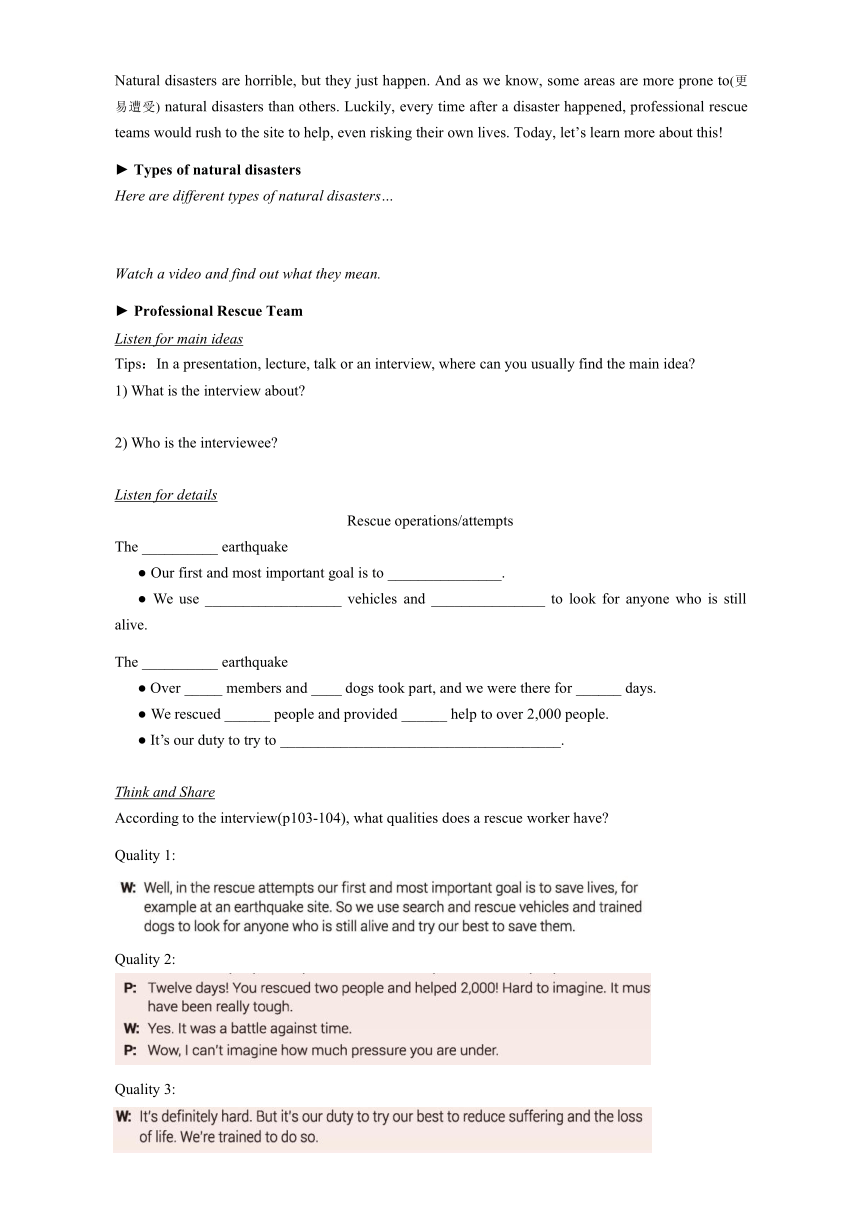
Natural disasters are horrible, but they just happen. And as we know, some areas are more prone to(更易遭受) natural disasters than others. Luckily, every time after a disaster happened, professional rescue teams would rush to the site to help, even risking their own lives. Today, let’s learn more about this! Types of natural disasters Here are different types of natural disasters… Watch a video and find out what they mean. Professional Rescue Team Listen for main ideas Tips:In a presentation, lecture, talk or an interview, where can you usually find the main idea 1) What is the interview about 2) Who is the interviewee Listen for details Rescue operations/attempts The _____ earthquake ● Our first and most important goal is to _____. ● We use _____ vehicles and _____ to look for anyone who is still alive. The _____ earthquake ● Over _____ members and ____ dogs took part, and we were there for _____ days. ● We rescued _____ people and provided _____ help to over 2,000 people. ● It’s our duty to try to _____. Think and Share According to the interview(p103-104), what qualities does a rescue worker have Quality 1: Quality 2: Quality 3: Note-taking Exercise 1 Tips: For the second time, listen and catch key words and take them down with symbols and abbreviations. For the third time, complete the notes. P:Today, we're talking about professional teams who work in natural disaster rescue. As you know,natural disasters like earthquakes, floods and landslides can cause death and other loss and damage that is hard to measure. … Today, Mr Wang from China International Search and Rescue Team is here to tell us all about this. W:Hello, everyone! P:… So what happens on your rescue attempts W:Well, in the rescue attempts our first and most important goal is to save lives, for example at an earthquake site. … P:Sounds like a very challenging process. How long does a rescue attempt usually take W:… Over sixty members and six dogs took part, and we were there for twelve days. … P:Twelve days! You rescued two people and helped 2,000! Hard to imagine. It must have been really tough. W:Yes. It was a battle against time. P:Wow, I can't imagine how much pressure you are under. W:… We're trained to do so. Note-taking Exercise 2 Tips: For the second time, listen and catch key words and take them down with symbols and abbreviations. For the third time, complete the notes. W:... So, we feel proud of what we do... P:Excuse me, Mr Wang, but can I interrupt you there You’ve told us a lot about how you conduct rescue attempts, but could you please tell us more about protection ... W:Right. ... If you’re indoors, stay away from anything that can break or fall, like windows or lamps. P:Ok, but what if I’m trapped Should I try to shout as loud as I can, or ... W:... P: Sorry for interrupting again. But why so W:... P: I didn’t know that—great advice! We’ve all learnt a lot today. ... So, I’m very sorry, but we’ll have to finish there. ... ...
~~ 您好,已阅读到文档的结尾了 ~~