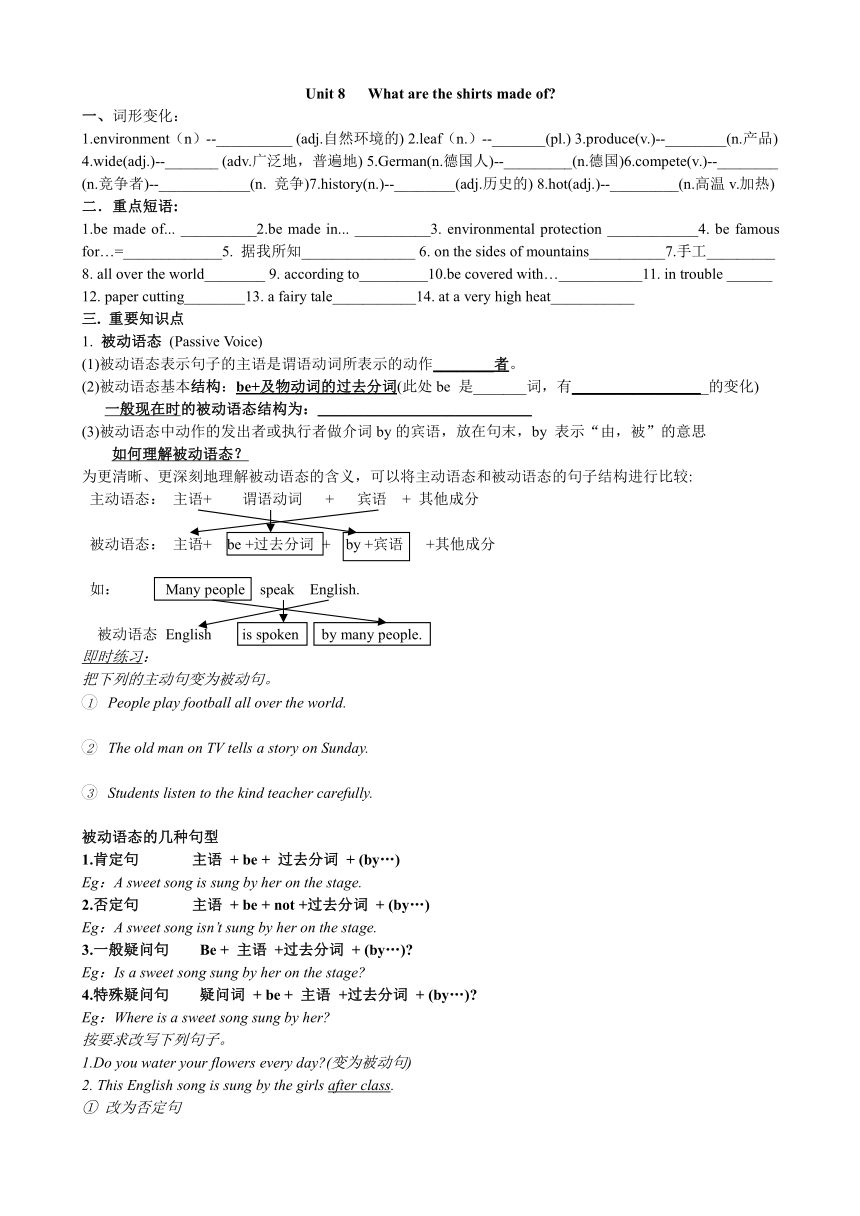
Unit 8 What are the shirts made of 一、词形变化: 1.environment(n)--_____ (adj.自然环境的) 2.leaf(n.)--_____(pl.) 3.produce(v.)--_____(n.产品) 4.wide(adj.)--_____ (adv.广泛地,普遍地) 5.German(n.德国人)--_____(n.德国)6.compete(v.)--_____ (n.竞争者)--_____(n. 竞争)7.history(n.)--_____(adj.历史的) 8.hot(adj.)--_____(n.高温v.加热) 二.重点短语: 1.be made of... _____2.be made in... _____3. environmental protection _____4. be famous for…=_____5. 据我所知_____ 6. on the sides of mountains_____7.手工_____ 8. all over the world_____ 9. according to_____10.be covered with…_____11. in trouble _____ 12. paper cutting_____13. a fairy tale_____14. at a very high heat_____ 三. 重要知识点 1. 被动语态 (Passive Voice) (1)被动语态表示句子的主语是谓语动词所表示的动作_____者。 (2)被动语态基本结构:be+及物动词的过去分词(此处be 是_____词,有_____的变化) 一般现在时的被动语态结构为:_____ (3)被动语态中动作的发出者或执行者做介词by的宾语,放在句末,by 表示“由,被”的意思 如何理解被动语态? 为更清晰、更深刻地理解被动语态的含义,可以将主动语态和被动语态的句子结构进行比较: 主动语态: 主语+ 谓语动词 + 宾语 + 其他成分 被动语态: 主语+ be +过去分词 + by +宾语 +其他成分 如: Many people speak English. 被动语态 English is spoken by many people. 即时练习: 把下列的主动句变为被动句。 People play football all over the world. The old man on TV tells a story on Sunday. Students listen to the kind teacher carefully. 被动语态的几种句型 1.肯定句 主语 + be + 过去分词 + (by…) Eg:A sweet song is sung by her on the stage. 2.否定句 主语 + be + not +过去分词 + (by…) Eg:A sweet song isn’t sung by her on the stage. 3.一般疑问句 Be + 主语 +过去分词 + (by…) Eg:Is a sweet song sung by her on the stage 4.特殊疑问句 疑问词 + be + 主语 +过去分词 + (by…) Eg:Where is a sweet song sung by her 按要求改写下列句子。 1.Do you water your flowers every day (变为被动句) 2. This English song is sung by the girls after class. ① 改为否定句 ②改为一般疑问句,并做肯定和否定回答 ③对划线提问 (4)含有双宾语的句子变被动语态: 双宾语:即直接宾语(常指事物)和间接宾语(常指人)的句子,每个宾语都可变为被动语态的主语,即其被动语态有两种形式,但多以间接宾语作主语。 Eg: Jack told us the truth.(变为被动语态) We were told the truth by Jack. The truth was told (to) us by Jack. 练习:He passes me the football. (改成被动语态) I _____ _____ the football by him. The football _____ _____ _____ me by him. (5)动词的主动形式表示被动之意 1)系动词无被动语态:以主动形式表示被动之意。常见的系动词有: be动词, look, seem, appear, feel, sound, smell, taste等 Eg: It smells terrible. That sounds good. 2) 不及物动词sell, wash, read, write, open, close, shut, lock, wear等,常用主动形式表示被动意义。 Eg: This book sells well. 这本书畅销。 The kind of cloth washes well. 这种布很容易洗。 3)下列动词(词组)没有被动式: happen, take place, break out, belong to, come out, cost, take Eg:An accident happened yesterday. 练一练: 用所给动词的正确形式填空。 ①Sunglasses _____ (use) for protecting people’s eyes. ②A picture _____ (put) up ... ...
~~ 您好,已阅读到文档的结尾了 ~~