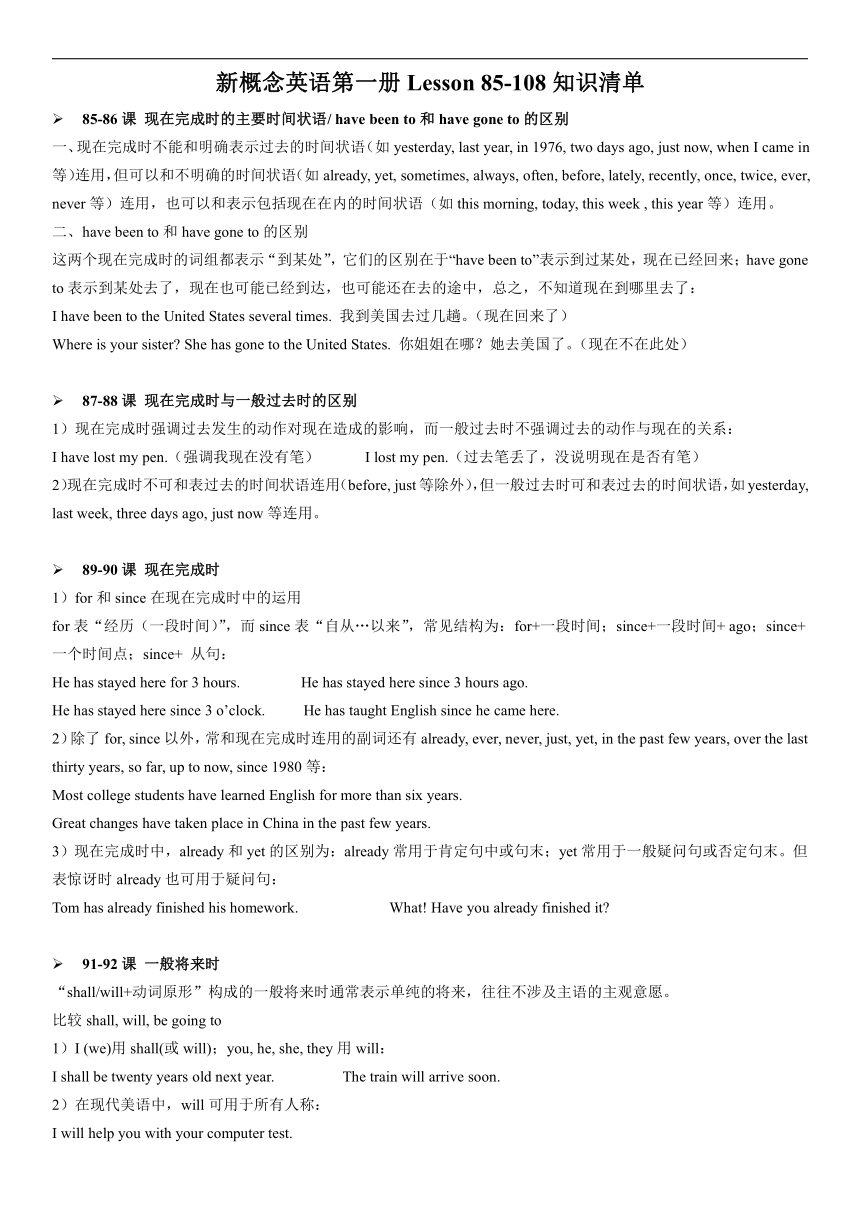
新概念英语第一册Lesson 85-108知识清单 85-86课 现在完成时的主要时间状语/ have been to和have gone to的区别 一、现在完成时不能和明确表示过去的时间状语(如yesterday, last year, in 1976, two days ago, just now, when I came in等)连用,但可以和不明确的时间状语(如already, yet, sometimes, always, often, before, lately, recently, once, twice, ever, never等)连用,也可以和表示包括现在在内的时间状语(如this morning, today, this week , this year等)连用。 二、have been to和have gone to的区别 这两个现在完成时的词组都表示“到某处”,它们的区别在于“have been to”表示到过某处,现在已经回来;have gone to表示到某处去了,现在也可能已经到达,也可能还在去的途中,总之,不知道现在到哪里去了: I have been to the United States several times. 我到美国去过几趟。(现在回来了) Where is your sister She has gone to the United States. 你姐姐在哪?她去美国了。(现在不在此处) 87-88课 现在完成时与一般过去时的区别 1)现在完成时强调过去发生的动作对现在造成的影响,而一般过去时不强调过去的动作与现在的关系: I have lost my pen.(强调我现在没有笔) I lost my pen.(过去笔丢了,没说明现在是否有笔) 2)现在完成时不可和表过去的时间状语连用(before, just等除外),但一般过去时可和表过去的时间状语,如yesterday, last week, three days ago, just now等连用。 89-90课 现在完成时 1)for和since在现在完成时中的运用 for表“经历(一段时间)”,而since表“自从…以来”,常见结构为:for+一段时间;since+一段时间+ ago;since+一个时间点;since+ 从句: He has stayed here for 3 hours. He has stayed here since 3 hours ago. He has stayed here since 3 o’clock. He has taught English since he came here. 2)除了for, since以外,常和现在完成时连用的副词还有already, ever, never, just, yet, in the past few years, over the last thirty years, so far, up to now, since 1980等: Most college students have learned English for more than six years. Great changes have taken place in China in the past few years. 3)现在完成时中,already和yet的区别为:already常用于肯定句中或句末;yet常用于一般疑问句或否定句末。但表惊讶时already也可用于疑问句: Tom has already finished his homework. What! Have you already finished it 91-92课 一般将来时 “shall/will+动词原形”构成的一般将来时通常表示单纯的将来,往往不涉及主语的主观意愿。 比较shall, will, be going to 1)I (we)用shall(或will);you, he, she, they用will: I shall be twenty years old next year. The train will arrive soon. 2)在现代美语中,will可用于所有人称: I will help you with your computer test. 3)shall/will的缩写形式相同,都是’ll: I shall= I’ll You will= You’ll She will=She’ll 4)shall not的缩写形式为shan’t;will not的缩写形式为won’t: They’ll take part in the sports meet next week. She won’t accept my suggestion. 5)be going to和will在含义和用法上略有不同: be going to往往表示事先经过考虑的打算;will多表示意愿、决心。有时不能互换。 I have bought some books and I am going to learn Korean by myself.(不能用will替换) 93-94课 一般将来时 常跟一般将来时连用的时间状语有: this morning/afternoon/evening in two days’ time in the morning tomorrow this week this month this year ... ...
~~ 您好,已阅读到文档的结尾了 ~~