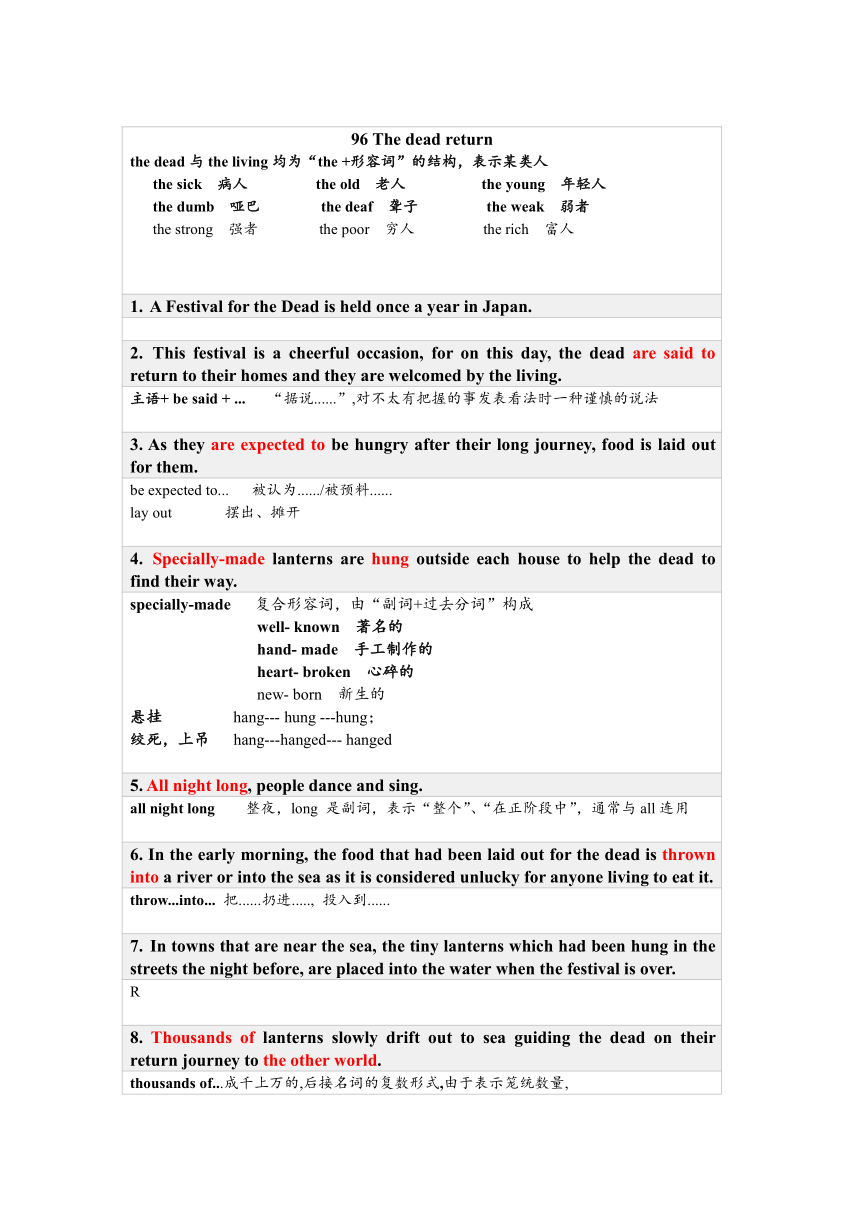
96 The dead return the dead与the living均为“the +形容词”的结构,表示某类人 the sick 病人 the old 老人 the young 年轻人 the dumb 哑巴 the deaf 聋子 the weak 弱者 the strong 强者 the poor 穷人 the rich 富人 1. A Festival for the Dead is held once a year in Japan. 2. This festival is a cheerful occasion, for on this day, the dead are said to return to their homes and they are welcomed by the living. 主语+ be said + ... “据说......”,对不太有把握的事发表看法时一种谨慎的说法 3. As they are expected to be hungry after their long journey, food is laid out for them. be expected to... 被认为....../被预料...... lay out 摆出、摊开 4. Specially-made lanterns are hung outside each house to help the dead to find their way. specially-made 复合形容词,由“副词+过去分词”构成 well- known 著名的 hand- made 手工制作的 heart- broken 心碎的 new- born 新生的 悬挂 hang-- hung --hung; 绞死,上吊 hang--hanged-- hanged 5. All night long, people dance and sing. all night long 整夜,long 是副词,表示“整个”、“在正阶段中”,通常与all连用 6. In the early morning, the food that had been laid out for the dead is thrown into a river or into the sea as it is considered unlucky for anyone living to eat it. throw...into... 把......扔进....., 投入到...... 7. In towns that are near the sea, the tiny lanterns which had been hung in the streets the night before, are placed into the water when the festival is over. R 8. Thousands of lanterns slowly drift out to sea guiding the dead on their return journey to the other world. thousands of...成千上万的,后接名词的复数形式,由于表示笼统数量, 前面不能加具体数字类似的还有hundreds / millions / billions of ... the other world 另一个世界 world可以与一些限定词连用以表示“今世/ 现世”、“来世”、“黄泉”表达“死”的委婉语 pass away 过世 end one’s day 寿终 breath one’s last 咽气 go to sleep 长眠 be no more 不在了 9. This is a moving spectacle, for crowds of people stand on the shore watching the lanterns drifting away until they can be seen no more. spectacle n. 壮观的景象; 精彩的表演; 出人意外的情况 易混单词 (1)usual 与usually ①usual通常为形容词,表示“通常的”、“平常的”、“惯常的”等。 It was warm last Sunday, so I went and sat on the river bank as usual. 上个星期日天气暖和,于是我和往常一样,又去河边坐着。 One Monday, there were fewer people in the shop than usual 有个星期一,这家商场里的人比往常少。 It it usual with him to get up late. 他常起得迟。 I parked the car at the usual place. 我在往常那个地方停了车。(usual既可以作表语,又可作定语) ②usually为频度副词,表示“平常”、“通常”。 What time do you usually wake up in the morning 通常你早晨几点钟醒? Police officers in the UK do not usually carry arms. 英国警察通常不携带武器。 (2)between和among ①介词between表示“在(两者)之间”。 The paper had fallen down between the desk and the wall. 那张纸掉在桌子和墙壁之间的缝隙里。 ②当表示两两之间的相互关系时,between可用于3个或3个以上的名词前。 The village lies between a river, a mountain and a road. 这个村子位于一条河、一座山和一条马路中 ... ...
~~ 您好,已阅读到文档的结尾了 ~~