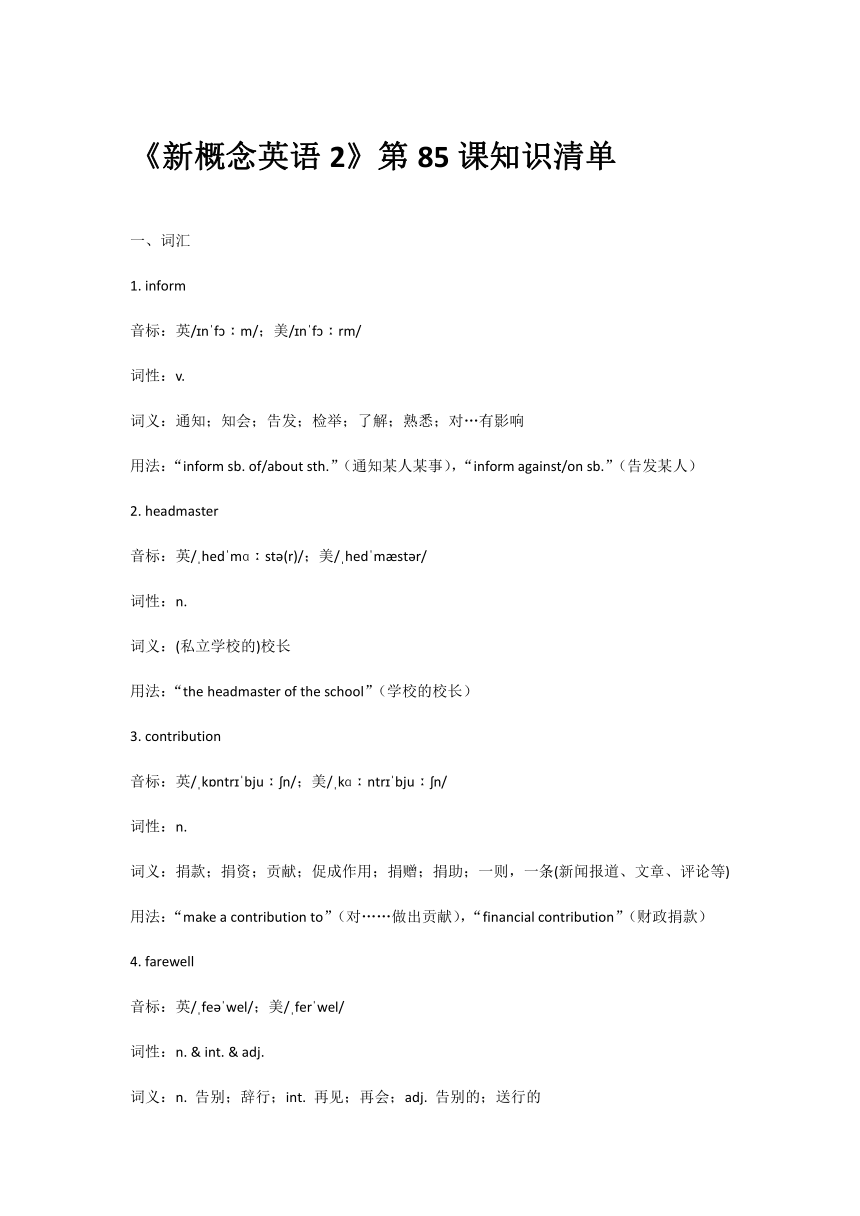
《新概念英语2》第85课知识清单 一、词汇 1. inform 音标:英/ n f m/;美/ n f rm/ 词性:v. 词义:通知;知会;告发;检举;了解;熟悉;对…有影响 用法:“inform sb. of/about sth.”(通知某人某事),“inform against/on sb.”(告发某人) 2. headmaster 音标:英/ hed mɑ st (r)/;美/ hed m st r/ 词性:n. 词义:(私立学校的)校长 用法:“the headmaster of the school”(学校的校长) 3. contribution 音标:英/ k ntr bju n/;美/ kɑ ntr bju n/ 词性:n. 词义:捐款;捐资;贡献;促成作用;捐赠;捐助;一则,一条(新闻报道、文章、评论等) 用法:“make a contribution to”(对……做出贡献),“financial contribution”(财政捐款) 4. farewell 音标:英/ fe wel/;美/ fer wel/ 词性:n. & int. & adj. 词义:n. 告别;辞行;int. 再见;再会;adj. 告别的;送行的 用法:“say farewell to sb.”(向某人告别),“a farewell party”(告别派对) 5. honour 音标:英/ n (r)/;美/ ɑ n r/ 词性:n. & v. 词义:n. 荣誉;光荣;尊敬;荣幸;尊重;崇敬;正义感;道义;气节;引以为荣的事;v. 尊敬;尊重;给予表扬(或奖励、头衔、称号);信守,执行(承诺) 用法:作名词,“in honour of”(为了纪念;为了向……表示敬意);作动词,“honour one's promise”(信守承诺) 二、重点句型 1. I have just received a letter from my old school, informing me that my former headmaster, Mr. Stuart Page, will be retiring next week. 语法点:现在完成时,“have just received”表示过去发生的动作对现在造成的影响 。“informing me that...”是现在分词短语作伴随状语 ,“that my former headmaster... will be retiring...”是宾语从句,作“informing”的宾语 ,将来进行时,“will be retiring”表示将来某个时间正在进行的动作 。 例句:I have just got a message from my friend, telling me that he will be arriving at the airport tomorrow.(我刚收到朋友的消息,告诉我他明天将到达机场。) 2. Pupils of the school, old and new, will be sending him a present to mark the occasion. 语法点:将来进行时,“will be sending”表示将来某个时间正在进行的动作 ,“to mark the occasion”是动词不定式作目的状语 。 例句:Students of the class, boys and girls, will be preparing a performance to celebrate the festival.(班里的学生,男生和女生,将准备一场表演来庆祝这个节日。) 3. It is a curious coincidence that the day before his retirement, Mr. Page will have been teaching for a total of forty years. 语法点:“It is... that...”是强调句型 ,强调“the day before his retirement” 。将来完成进行时,“will have been teaching”表示从过去开始一直持续到将来某个时间的动作 ,这个动作在将来某个时间之前一直在进行 ,可能刚刚结束,也可能还在进行 。 例句:It is a strange coincidence that the day before her birthday, she will have been working in this company for exactly five years.(很巧的是,在她生日的前一天,她将在这家公司工作整整五年了。) 三、语法聚焦 1. 现在完成时 构成:主语+have/has+过去分词 。当主语是第三人称单数时用has,其他人称用have 。 用法:表示过去发生的动作对现在造成的影响或结果 ,常与already、yet、just等副词连用 ;表示从过去开始一直持续到现在的动作或状态 ,常与“for + 时间段”“since + 时间点”等连用 。如“I have already finished my homework.”(我已经完成作业了) ;He ha ... ...
~~ 您好,已阅读到文档的结尾了 ~~