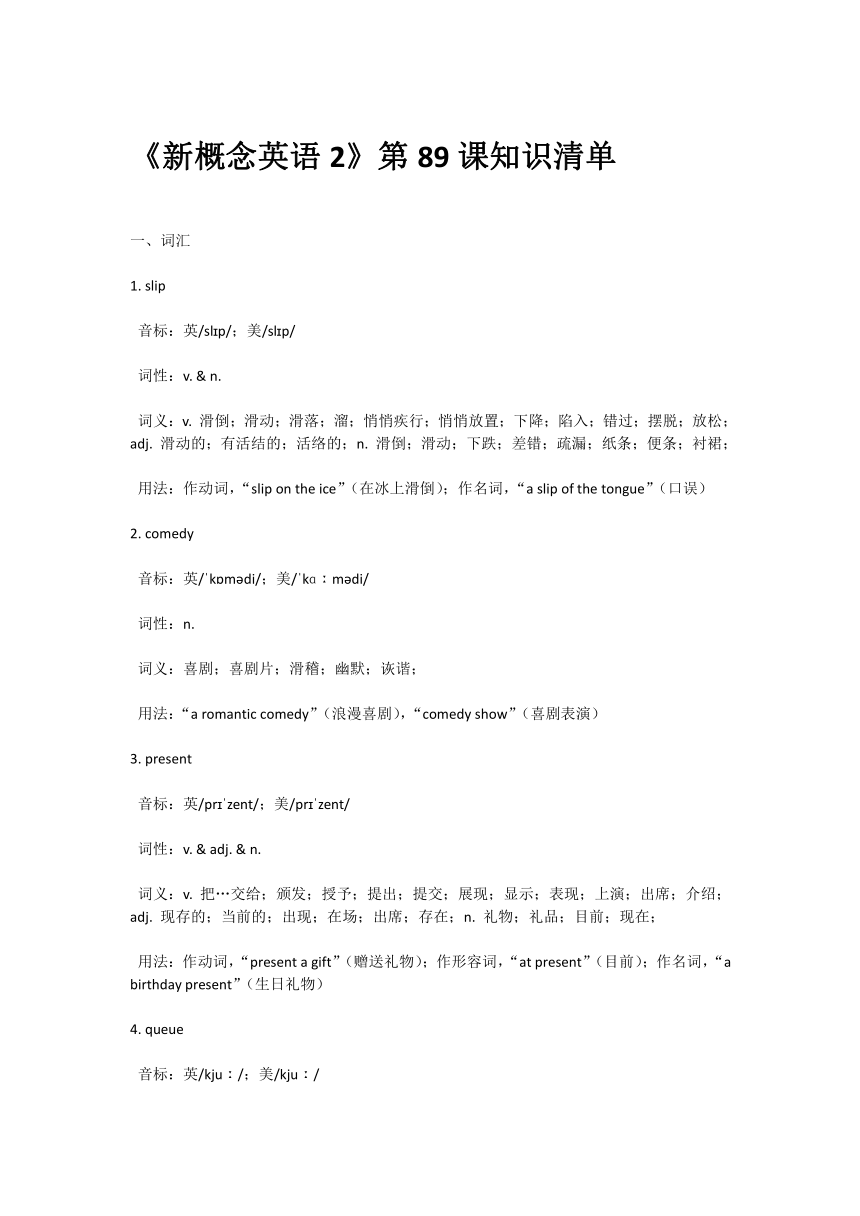
《新概念英语2》第89课知识清单 一、词汇 1. slip 音标:英/sl p/;美/sl p/ 词性:v. & n. 词义:v. 滑倒;滑动;滑落;溜;悄悄疾行;悄悄放置;下降;陷入;错过;摆脱;放松;adj. 滑动的;有活结的;活络的;n. 滑倒;滑动;下跌;差错;疏漏;纸条;便条;衬裙; 用法:作动词,“slip on the ice”(在冰上滑倒);作名词,“a slip of the tongue”(口误) 2. comedy 音标:英/ k m di/;美/ kɑ m di/ 词性:n. 词义:喜剧;喜剧片;滑稽;幽默;诙谐; 用法:“a romantic comedy”(浪漫喜剧),“comedy show”(喜剧表演) 3. present 音标:英/pr zent/;美/pr zent/ 词性:v. & adj. & n. 词义:v. 把…交给;颁发;授予;提出;提交;展现;显示;表现;上演;出席;介绍;adj. 现存的;当前的;出现;在场;出席;存在;n. 礼物;礼品;目前;现在; 用法:作动词,“present a gift”(赠送礼物);作形容词,“at present”(目前);作名词,“a birthday present”(生日礼物) 4. queue 音标:英/kju /;美/kju / 词性:n. & v. 词义:n. (人或车辆)队;行列;(储存的数据)队列;v. (人、车等)排队等候;(使)排队;列队等待; 用法:作名词,“stand in a queue”(排队站着);作动词,“queue up”(排队) 5. fortunate 音标:英/ f t n t/;美/ f rt n t/ 词性:adj. 词义:幸运的;交好运的;吉利的; 用法:“be fortunate to do sth.”(有幸做某事),“be fortunate in”(在……方面幸运) 二、重点句型 1. People will do anything to see a free show - even if it is a bad one. 语法点:一般将来时,“will do”描述将来发生的动作 ,“even if”引导让步状语从句 ,表示“即使,尽管” ,从句用一般现在时 。 例句:They will try their best to win the game - even if it is very difficult.(他们会尽最大努力赢得比赛,即使这非常困难。) 2. As the actors could not remember their lines, the performance was a total failure. 语法点:一般过去时,“could not remember”“was”描述过去发生的动作和状态 ,“as”引导原因状语从句 ,表示“因为” 。 例句:As the students didn't review their lessons, the test results were disappointing.(因为学生们没有复习功课,考试结果令人失望。) 3. Many people were waiting outside the theatre, queuing up for tickets. 语法点:过去进行时,“were waiting”描述过去某个时间正在进行的动作 ,“queuing up for tickets”是现在分词短语作伴随状语 。 例句:A lot of customers were shopping in the mall, looking for bargains.(许多顾客在商场里购物,寻找便宜货。) 三、语法聚焦 1. 一般将来时 构成: will/shall + 动词原形:will可用于所有人称;shall用于第一人称(I/we) 。 be going to + 动词原形:表示打算、计划做某事 ;表示根据某种迹象表明很可能发生某事 。 现在进行时表将来:一些表示位置移动的动词,如“come”“go”“leave”“start”等,用现在进行时表示按计划或安排即将发生的动作 。 用法:表示将来某个时间要发生的动作或存在的状态 。如“I will go to school tomorrow.”(我明天要去上学) ;“He is going to visit his grandparents this weekend.”(他这个周末打算去看望他的祖父母) 。 2. 让步状语从句 引导词:“although”(虽然,尽管)、“though”(虽然,尽管)、“even if”(即使,尽管)、“even though”(即使,尽管)、“while”(虽然 ,位于句首 )、“however”(无论如何,不管怎样)、“whatever”(无论什么)、“whoever”(无论谁)、“whichever”(无论哪个 ... ...
~~ 您好,已阅读到文档的结尾了 ~~