鲁教版六年级下册(五四学制)英语期末复习 Unit 5 Keep Fit 知识与练习 学案(含答案)
日期:2025-12-17科目:英语类型:初中学案查看:49次大小:23973B来源:二一课件通
预览图 1/5 张
学案,练习,知识,Fit,Keep,复习
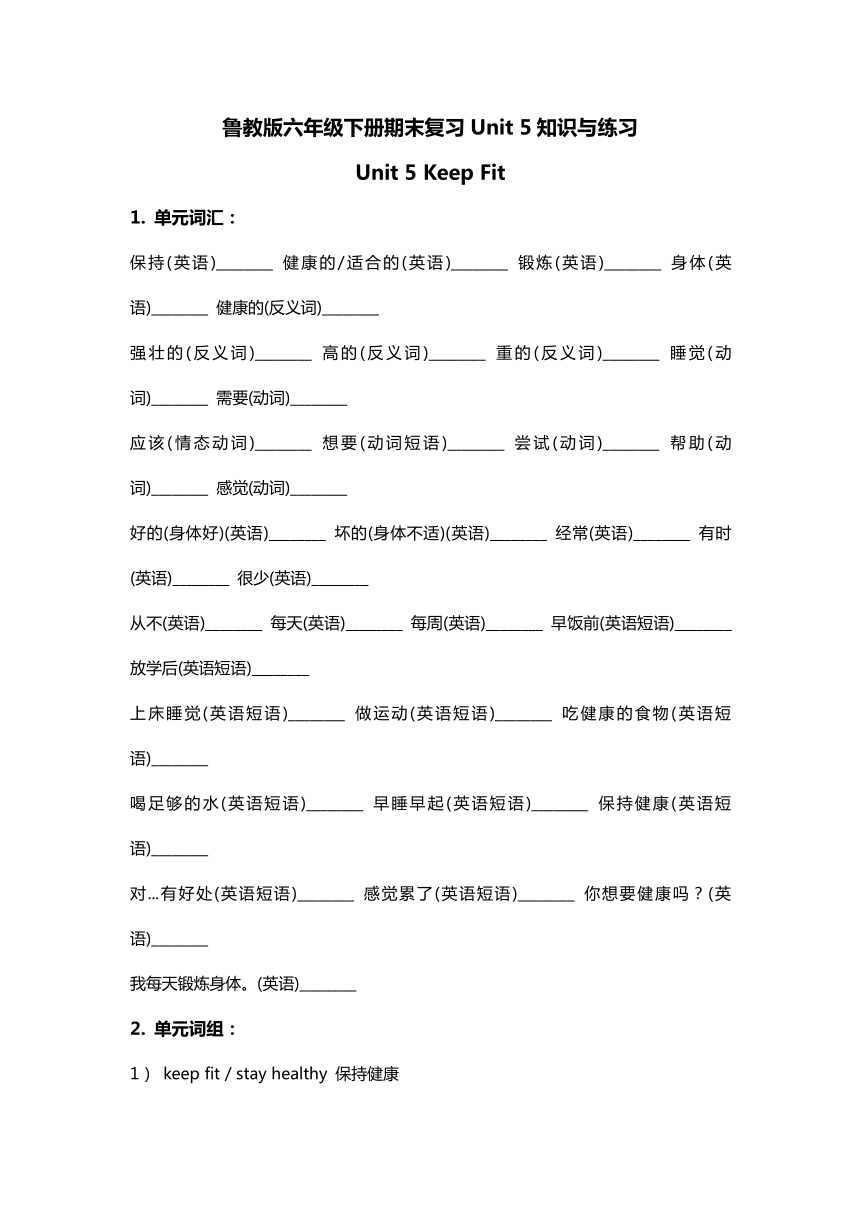
鲁教版六年级下册期末复习Unit 5知识与练习 Unit 5 Keep Fit 1. 单元词汇: 保持(英语)_____ 健康的/适合的(英语)_____ 锻炼(英语)_____ 身体(英语)_____ 健康的(反义词)_____ 强壮的(反义词)_____ 高的(反义词)_____ 重的(反义词)_____ 睡觉(动词)_____ 需要(动词)_____ 应该(情态动词)_____ 想要(动词短语)_____ 尝试(动词)_____ 帮助(动词)_____ 感觉(动词)_____ 好的(身体好)(英语)_____ 坏的(身体不适)(英语)_____ 经常(英语)_____ 有时(英语)_____ 很少(英语)_____ 从不(英语)_____ 每天(英语)_____ 每周(英语)_____ 早饭前(英语短语)_____ 放学后(英语短语)_____ 上床睡觉(英语短语)_____ 做运动(英语短语)_____ 吃健康的食物(英语短语)_____ 喝足够的水(英语短语)_____ 早睡早起(英语短语)_____ 保持健康(英语短语)_____ 对...有好处(英语短语)_____ 感觉累了(英语短语)_____ 你想要健康吗?(英语)_____ 我每天锻炼身体。(英语)_____ 2. 单元词组: 1) keep fit / stay healthy 保持健康 2) do exercise / do sports 做运动 3) play sports (like basketball/football) 进行体育运动(如篮球/足球) 4) be good for health 对健康有益 5) be bad for health 对健康有害 6) get enough sleep 获得充足的睡眠 7) go to bed early / late 早睡 / 晚睡 8) get up early / late 早起 / 晚起 9) eat healthy food 吃健康食品 10) drink enough water 喝足够的水 11) feel good / well / tired / bad 感觉好/健康/累/不舒服 12) want to be healthy/strong 想要健康/强壮 13) try to do sth. 尽力做某事 (e.g. try to eat more vegetables) 14) help sb. (to) do sth. 帮助某人做某事 (e.g. help me keep fit) 15) before breakfast / after school / at night 早饭前 / 放学后 / 在晚上 16) every day / week 每天 / 每周 17) how often 多久一次 (询问频率) 18) not...at all 一点也不 (e.g. I don't like it at all.) 19) a lot / very much 非常 (e.g. I like it a lot.) 20) have a healthy lifestyle 拥有健康的生活方式 3. 单元句型: 1) 表达习惯/频率: * I/You/We/They often/sometimes/seldom/never do exercise. (我/你(们)/我们/他们经常/有时/很少/从不做运动。) * He/She often/sometimes/seldom/never does exercise. (他/她经常/有时/很少/从不做运动。) * How often do you/they do exercise (你/你们/他们多久做一次运动?) — Once/Twice a week./Every day./... * How often does he/she do exercise (他/她多久做一次运动?) 2) 给出健康建议: * You/We/They should do exercise every day. (你/你们/我们/他们应该每天锻炼。) * He/She should get enough sleep. (他/她应该保证充足睡眠。) * You/We/They shouldn't go to bed late. (你/你们/我们/他们不应该晚睡。) * He/She shouldn't eat too much junk food. (他/她不应该吃太多垃圾食品。) 3) 谈论必要性: * I/You/We/They need to do exercise. (我/你(们)/我们/他们需要锻炼。) * He/She needs to eat healthy food. (他/她需要吃健康食物。) 4) 表达意愿: * I want to be healthy/strong. (我想要健康/强壮。) * He/She wants to keep fit. (他/她想要保持健康。) 5) 描述益处/害处: * Doing exercise is good for (your/our) health. (做运动对(你的/我们的)健康有益。) * Junk food is bad for (your/our) health. (垃圾食品对(你的/我们的)健康有害。) 6) 描述感觉: * I feel good/well/tired/bad. (我感觉很好/健康/累/不舒服。) * He/She feels good/well/tired/bad. (他/她感觉很好/健康/累/不舒服。) 7 ... ...