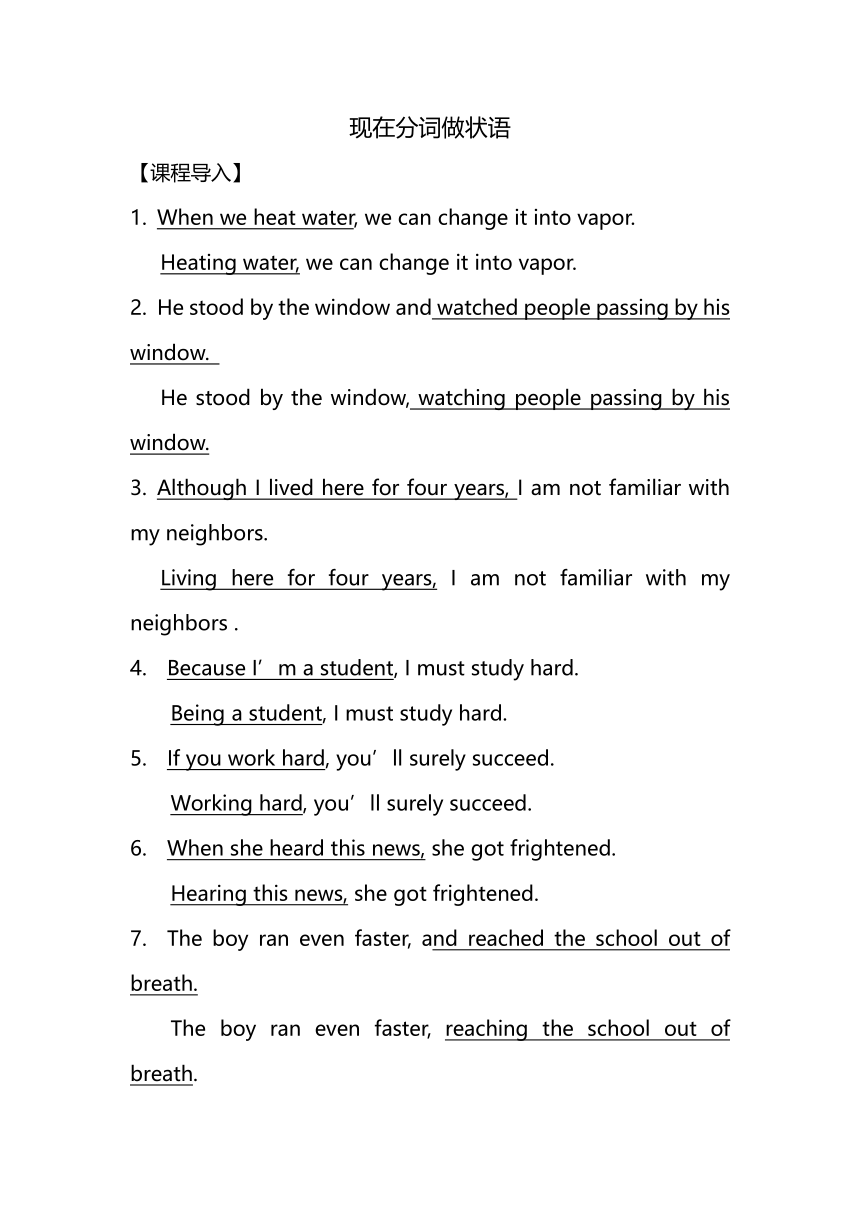
现在分词做状语 【课程导入】 When we heat water, we can change it into vapor. Heating water, we can change it into vapor. He stood by the window and watched people passing by his window. He stood by the window, watching people passing by his window. Although I lived here for four years, I am not familiar with my neighbors. Living here for four years, I am not familiar with my neighbors . Because I’m a student, I must study hard. Being a student, I must study hard. If you work hard, you’ll surely succeed. Working hard, you’ll surely succeed. When she heard this news, she got frightened. Hearing this news, she got frightened. The boy ran even faster, and reached the school out of breath. The boy ran even faster, reaching the school out of breath. After the boy finished his homework, the boy went out to play football. Having finished his homework, the boy went out to play football. After he turned off the TV set, he began to do his homework. Having turned off the TV set, he began to do his homework. Because the mother didn’t hear from her son for a long time, the mother worried a great deal. Not having heard from her son for a long time, the mother worried a great deal. Because the coat wasn’t washed in the correct way, the coat has faded. Not having been washed in the correct way, the coat has faded. 【知识点】 -ing分词的构成 -ing分词是由动词原形加词尾-ing构成。-ing分词同样有时态和语态的变化,通常有下表几种形式(以do为例): 主动形式 被动形式 一般式 doing being done 完成式 having done having been done -ing分词的否定形式是由not 加-ing分词构成。如: Not knowing his address, I could do nothing but stay at home and wait.不知道他的地址,我只好在家里等着。 -ing分词的一般式和完成式: -ing分词的一般式表示和谓语动词所表示的动作同时进行的动作;完成式表示在谓语动词所表示的动作之前发生的动作。如: ?Being a student, he was interested in books.?? 作为一个学生,他对书本很感兴趣。 Not having studied his lessons very hard, he failed the examinations. 因为没有努力学习功课,他考试不及格。 -ing分词的被动式 -ing分词的被动式表示它的逻辑主语是-ing分词动作的承受者。根据-ing分词动作发生的时间,-ing分词的被动式有一般被动式(being done)和完成被动式(having been done)。如: Having been criticized by the teacher, he gave up smoking. ?????? 被老师批评以后,他把烟戒了。 【知识点】 现在分词作状语 -ing分词作状语可以表示时间、原因、结果、条件、让步、方式或伴随情况等。 -ing分词短语作时间状语,相当于一个时间状语从句,有时可由连词when, while引出。如: While reading the book, he nodded from time to time. 他一边看书,一边不时地点头。 Seeing those pictures, she remembered her childhood.? 看到那些画,她想起了她的童年。 -ing分词短语作原因状语,相当于一个原因状语从句。如: Not knowing his address, I can’t send this book to him.?? 因为不知道他的地址,我不能把这本书送给他。 Being so excited, Many of us couldn’t go to sleep that night. 因为非常激动,那晚我们许多人都没睡着 –ing分词短语作结果状语。如: His father died, leaving him a lot of money.?? 他父亲死了,留给他许多钱。 She was so angr ... ...
~~ 您好,已阅读到文档的结尾了 ~~