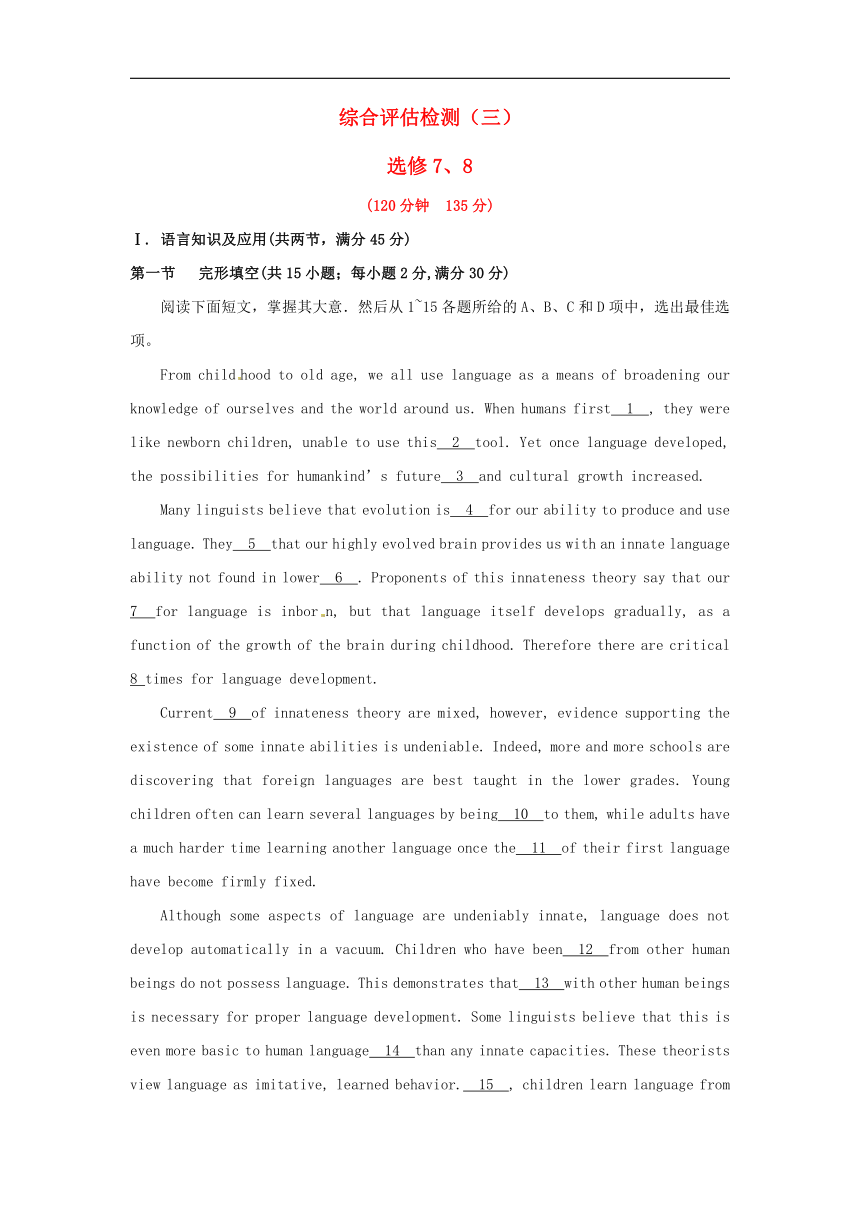
综合评估检测(三) 选修7、8 (120分钟 135分) Ⅰ. 语言知识及应用(共两节,满分45分) 第一节 完形填空(共15小题;每小题2分,满分30分) 阅读下面短文,掌握其大意.然后从1~15各题所给的A、B、C和D项中,选出最佳选项。 From childhood to old age, we all use language as a means of broadening our knowledge of ourselves and the world around us. When humans first 1 , they were like newborn children, unable to use this 2 tool. Yet once language developed, the possibilities for humankind’s future 3 and cultural growth increased. Many linguists believe that evolution is 4 for our ability to produce and use language. They 5 that our highly evolved brain provides us with an innate language ability not found in lower 6 . Proponents of this innateness theory say that our 7 for language is inborn, but that language itself develops gradually, as a function of the growth of the brain during childhood. Therefore there are critical 8 times for language development. Current 9 of innateness theory are mixed, however, evidence supporting the existence of some innate abilities is undeniable. Indeed, more and more schools are discovering that foreign languages are best taught in the lower grades. Young children often can learn several languages by being 10 to them, while adults have a much harder time learning another language once the 11 of their first language have become firmly fixed. Although some aspects of language are undeniably innate, language does not develop automatically in a vacuum. Children who have been 12 from other human beings do not possess language. This demonstrates that 13 with other human beings is necessary for proper language development. Some linguists believe that this is even more basic to human language 14 than any innate capacities. These theorists view language as imitative, learned behavior. 15 , children learn language from their parents by imitating them. Parents gradually shape their children’s language skills by positively reinforcing precise imitations and negatively reinforcing imprecise ones. 1. A. generated B. evolved C. born D. originated 2. A. valuable B. appropriate C. convenient D. favorite 3. A. attainments B. feasibility C. entertainments D. evolution 4. A. essential B. available C. reliable D. responsible 5. A. confirm B. inform C. claim D. convince 6. A. organizations B. organisms C. humans D. children 7. A. potential B. performance C. preference D. passion 8. A. ideological B. biological C. social D. psychological 9. A. reviews B. references C. reactions D. recommendations 10. A. revealed B. exposed C. engaged D. involved 11. A. regulations B. formations C. rules D. constitutions 12. A. distinguished B. divided C. protected D. isolated 13. A. exposition B. comparison C. contrast D. interaction 14. A. acquisition B. appreciation C. requirement D. alternative 15. A. As a result B. After all C. In other words D. Above all 第二节 语法填空(共10小题;每小题1. 5分,满分15分) 阅读下面短文,按照句子结构的语法性和上下文连贯的要求,在空格处填 ... ...
~~ 您好,已阅读到文档的结尾了 ~~